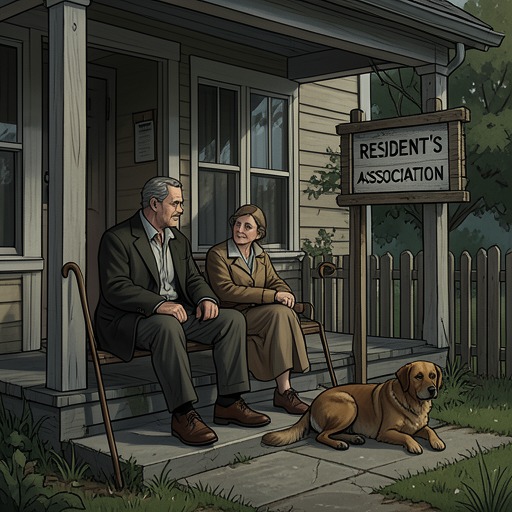
Ove and Rune’s friendship and longstanding enmity
A Man Called OveOve and Rune’s friendship is built out of contradiction: they feud over domestic and neighborhood matters, yet repeatedly recognize when the other needs help. Their relationship lasts through decades of changing neighbors and recurring disputes, and its most revealing moments come when each man acts without waiting for the other to ask. The novel presents their closeness not as an end to antagonism but as a durable form of loyalty that can reappear beneath it.
A friendship conducted through rivalry
The houses between Ove’s and Rune’s are occupied over the years by a succession of people whom both men tend to regard as unreasonable, regardless of whether they are currently on good terms. Their shared judgment of the neighbors offers a dry measure of their compatibility: even during a feud, they can agree about the people next door. It also establishes the residential block as the setting in which their relationship is repeatedly tested, renewed, and observed by others.
One particularly disruptive tenancy brings three young men whose parties, noise, and visitors disturb the block. Ove goes over to object and later plans to pursue the landlord through lawyers and the tax authorities. Before he can put that campaign into effect, he sees Rune go toward the parking area with his car keys and return with a plastic bag whose contents Ove cannot identify. The next day, police arrest the tenants after drugs are found in their shed following an anonymous tip. Ove and Rune meet eyes in the street; Ove affects ignorance of where anyone might obtain narcotics. The scene leaves the exact source of the tip unstated, but gives their exchange the character of tacit recognition: each can understand the other’s role without making it explicit.
Their alliance does not erase the feud. Ove eventually asks after Rune’s car, and Rune replies that it runs like a Swiss watch. They remain on good terms for two months, then fall out again over the heating system. Anita observes that the peaceful interval was pleasant while it lasted. The briefness of the truce is part of the relationship’s pattern: cooperation is genuine, but disagreement is not an exceptional breakdown that permanently ends their regard for one another.
Acting together when a neighbor is in danger
That pattern becomes clearest during the abuse of a woman and her young son living nearby. Sonja and Anita initially try to interpret the woman’s bruises and the shouting as private family difficulties. The situation changes when, over two nights, the neighboring houses hear the woman cry out and the boy plead for the man to stop. Ove goes outside; Rune is already waiting. They have been locked in one of their worst power struggles in the Residents’ Association and have barely spoken for almost a year. Neither offers a formal apology or proposes a truce. They exchange a glance, go back inside, and return fully dressed two minutes later.
When they confront the abusive man, he attacks them, and the encounter escalates before Rune helps bring it to an end. The next day the man leaves and does not return. The woman and her son stay with Anita and Rune for two weeks, until she feels able to return home. Ove and Rune then go to the bank together; that evening, Sonja and Anita tell the woman that the money they have arranged for her can be understood as either a gift or a loan, but is not open to debate. The intervention thus extends beyond stopping an immediate threat: the two households provide temporary shelter and financial help so the woman and her son can remain in their home. The boy is Jimmy, whose life will later connect him to the people around Ove and Rune.
From old feuds to shared care
In the present-day strand, Rune is seriously ill with Alzheimer’s and uses a wheelchair. When Rune’s wife explains his condition, Ove responds impatiently, though he shows a faint recognition of having heard it before from Sonja. Parvaneh then offers Ove’s help with the radiators, and Rune’s wife accepts. The small domestic request sits beside the larger history: Ove may not make a tender display of concern, but his practical usefulness remains available to the household next door. His brusque manner and his willingness to help are not opposites in this relationship; they are both part of how care is expressed.
Ove’s response becomes more urgent when Jimmy tells him that Rune is to be taken away. Ove checks that the news is certain and immediately heads to Anita’s house, where he demands to see the authorities’ papers. His haste turns concern into direct action. Later, when The man in the white shirt arrives with three young nurses, document in hand, Anita places herself in his way and insists that she will care for Rune. The man tries to proceed, but Ove appears behind her and says that he will help care for Rune too. This promise places Ove beside Anita rather than treating her as someone who must face the decision alone.
A bond that survives without a truce
Afterward, Ove spends a long time in the living room talking privately with Rune. He has taken Parvaneh, Anita, and Patrick into the kitchen so that the two men can talk without interruption. Anita thinks she hears Rune laugh several times. The novel does not disclose what they say, or present their conversation as a final settlement of every old disagreement. Its significance lies instead in the renewed privacy and attention: Ove stays with his friend, and Rune seems, for a while, able to answer in a way that recalls their shared life beyond illness and official decisions.
Their history therefore resists a simple division between friendship and hostility. The two can contest Association leadership, fall out over a heating system, and remain silent for months; they can also respond together to danger, coordinate material help, and stand beside Anita when Rune’s care is at stake. Their loyalty is practical and sometimes wordless, expressed through a returned glance, a joint visit, or the work of staying in the room. The relationship’s strength is not that the quarrels disappear, but that the quarrels never wholly cancel the responsibility each man feels toward the other.